TDS on Sale of Property by NRI: Rates, Form 27Q & Latest 2026 Rules
Quick Answer
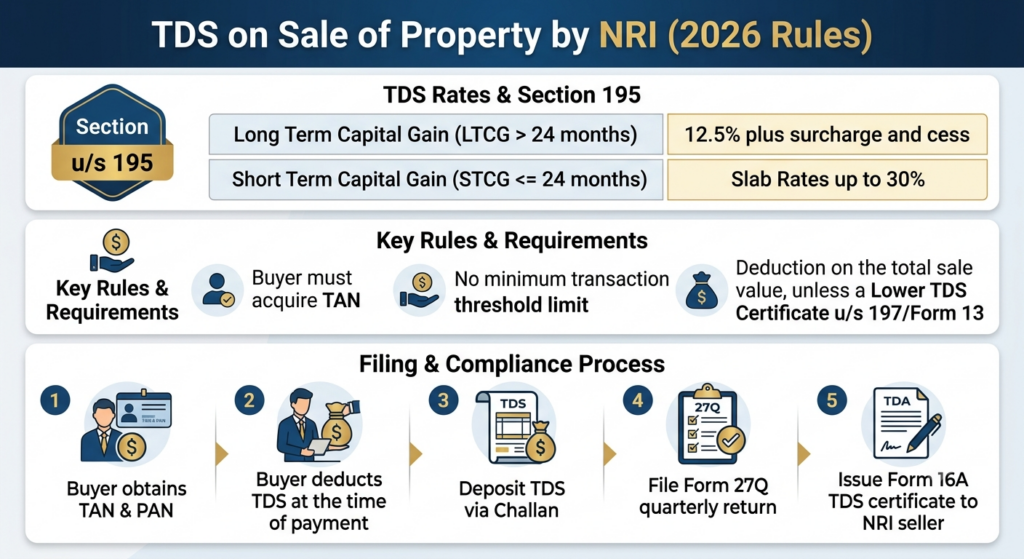
Buying property from an NRI seller involves a different TDS process from a regular resale transaction. The buyer must deduct TDS under Section 195, rather than Section 194IA, and file Form 27Q instead of Form 26QB. The applicable rate is generally 20% for long-term capital gains and 30% for short-term capital gains, along with applicable surcharge and cess. A lower deduction certificate may significantly reduce the amount of TDS payable. This guide explains the applicable rates, the correct forms, the TDS deposit process, and the key compliance requirements for buyers.
Tax rules shift often, and TDS on NRI property sales sits at the crossing point of the Income Tax Act and regular Finance Act updates. This guide reflects the rules generally understood to apply in 2026, but every transaction carries its own details. Please confirm current rates and forms with a chartered accountant or the Income Tax Department before you deduct, deposit, or file anything. This article is meant to inform, not to replace professional tax advice.
Buying property from a Non-Resident Indian works differently from a standard resale. The tax deduction step trips up more buyers than almost any other part of the transaction. Indian tax law treats an NRI seller’s capital gain as income earned in India. This means the buyer, not the seller, carries the legal duty to withhold tax at the time of payment.
Get this step wrong, and the buyer can face penalties and interest. Years of correction paperwork often follow too. The NRI seller, meanwhile, can end up with far more tax withheld than actually owed. Anyone financing this purchase with a home loan can also check ASBL’s guide on tripartite agreements. It covers a different piece of the puzzle, worth understanding alongside TDS. This guide walks through the rates, the correct form, the deposit process, and what changed in 2026.
Why TDS Applies When Buying Property from an NRI
Section 195 of the Income Tax Act requires TDS on any payment made to a non-resident. This applies whenever that payment is taxable in India. A property sale by an NRI falls squarely within this rule. Compare this to a typical resident-to-resident sale. There, TDS under Section 194IA applies only once the sale value crosses Rs 50 lakh.
Be Among the First to Own a Legacy
For an NRI seller, TDS applies no matter the sale value. Section 195 carries no minimum threshold at all. A buyer purchasing even a modestly priced flat from an NRI still has to deduct tax first. This detail catches many first-time buyers off guard.
TDS Rates on NRI Property Sale: Short-Term vs Long-Term Gains
The applicable TDS rate depends on how long the NRI has held the property. A property held for more than two years counts as long-term. Long-term capital gains generally attract TDS at 20 percent. A property held two years or less counts as short-term. Short-term capital gains generally attract TDS at 30 percent. Both rates carry surcharge and cess on top. These vary depending on the seller’s total income.
Take a straightforward example. Suppose an NRI sells a Hyderabad apartment for Rs 80 lakh. The property has been held for more than two years. Any gain, then, counts as long-term. Without a lower deduction certificate, the buyer must deduct TDS at 20 percent of the full sale value. That works out to Rs 16 lakh, deducted before the balance reaches the seller. Surcharge and cess apply on top of this base rate too, pushing the actual figure higher still.
Now suppose the seller’s actual capital gain works out to only Rs 20 lakh. This accounts for the original purchase cost and eligible deductions. Deducting 20 percent TDS on the full Rs 80 lakh sale value clearly overshoots the seller’s real tax bill. The gap between the two is wide. This is exactly the gap a lower deduction certificate is designed to close.(Source)
Form 27Q: What It Is and How to File It
TDS on an NRI’s property sale falls under Section 195, not Section 194IA. Because of this, the buyer files Form 27Q instead of the more familiar Form 26QB. Form 26QB combines a challan and statement for resident sellers. It differs from Form 27Q, a quarterly TDS return built for payments to non-residents.
Filing Form 27Q correctly matters more than it might seem. The seller’s PAN, the correct TDS rate, and the deduction date all need to line up accurately. Any mismatch can delay the seller’s ability to claim credit for tax already deducted.
Step-by-Step: Deducting and Depositing TDS Correctly
A resident buyer purchasing property from an NRI generally needs to follow four clear steps.
- Get a Tax Deduction Account Number. TDS under Section 195 has traditionally required a TAN, not just a PAN. This differs from the simpler process available to resident sellers.
- Deduct TDS at the applicable rate when paying the seller. This applies whether the payment happens in one transaction or several instalments.
- Deposit the deducted amount with the government within the prescribed timeline.
- File Form 27Q for the relevant quarter, then issue Form 16A to the seller once the return is processed. The seller needs this certificate to claim credit for the tax withheld.
Missing any of these steps can create problems well after the sale closes. Late deposits attract interest. A seller may also struggle to file their Indian tax return correctly.
How NRI Sellers Can Reduce TDS with a Lower Deduction Certificate
An NRI seller does not have to accept TDS on the entire sale value. Under Section 197, the seller can apply in Form 13 through the TRACES portal. This must happen before the sale closes. The application asks the assessing officer to certify a lower, or even nil, deduction rate. This reflects the actual capital gain, not the full sale price.
A lower deduction certificate matters most when the seller’s real gain sits well below the sale value. That’s common when a property has appreciated only moderately. It also applies when improvement costs reduce the taxable gain. Applying early is worth stressing too. The certificate needs processing time. It cannot be arranged at the last minute.(Source)
What Changed in 2026: PAN-Based Challan and Other Updates
One meaningful shift for NRI property transactions is set to take effect from October 2026. TDS payment under Section 195 is moving towards a PAN-based challan system. This replaces the current TAN-based process. In practice, this should work much like Section 194IA already works for resident sellers. Buyers there can deduct and deposit tax using just a PAN, without first getting a TAN.
This change should ease a genuine point of friction for first-time buyers. Getting a TAN purely for a one-time property purchase has long felt like an unnecessary extra step. That said, rollouts like this can shift in scope or timing. Buyers finalising a purchase close to this date should confirm the current requirement first. A quick check with the bank or a tax professional is enough.
Common Mistakes Buyers and Sellers Should Avoid
A few recurring mistakes cause most of the complications in NRI property transactions. Nearly all of them are avoidable with a bit of advance planning.
Do’s
- Confirm whether the seller is an NRI before assuming Section 194IA and Form 26QB apply.
- Apply for a lower deduction certificate well before the sale closes, if the seller’s actual gain is meaningfully lower than the sale value.
- Verify the seller’s PAN and residency status in writing before deducting TDS.
- Check the property’s original RERA registration and developer track record too, using ASBL’s Telangana RERA checklist or its beginner’s guide to TS-RERA. This matters even when buying from an individual NRI seller, not a developer directly.
Don’ts
- Deduct TDS using Form 26QB for an NRI seller, since this is the wrong form and section entirely.
- Withhold TDS only on the capital gain amount without a valid lower deduction certificate in hand.
- Assume TDS doesn’t apply just because the sale value is below Rs 50 lakh.
- Wait until the day of registration to sort out TAN, PAN, or certificate paperwork.
Key Takeaways
- TDS applies under Section 195, not Section 194IA, whenever the seller is an NRI, no matter the sale value.
- Long-term gains generally attract 20 percent TDS, and short-term gains attract 30 percent, both plus surcharge and cess.
- Form 27Q is the correct return for NRI seller transactions, not Form 26QB.
- TDS applies to the full sale value unless the seller holds a lower or nil deduction certificate obtained through Form 13.
- From October 2026, TDS payment is expected to shift toward a PAN-based challan process. Buyers should confirm the current requirement closer to the date.
- Tax rules change often. Always confirm the latest rates and forms with a chartered accountant or the Income Tax Department before completing the transaction.