Home Loan Eligibility 2026: Salary, CIBIL & Age Criteria Explained
Quick Answer
Home loan eligibility in 2026 depends primarily on your income, existing EMIs, CIBIL score, age, loan tenure and the property’s eligibility with the lender. FOIR determines how much of your income can go towards the new EMI, while RBI’s LTV limits determine how much of the property’s value can actually be financed. If your eligibility falls short, adding a co-applicant, closing existing debt, improving your CIBIL score, extending the tenure or increasing your down payment can improve the outcome.
You’ve found a property, or you’re close to it, and the real question underneath everything else is simple: will a bank actually lend you enough. This guide answers that in three parts, how much you’ll likely get, whether you’ll be approved, and, most importantly, exactly what’s holding your number down and what you can do about it. If the honest answer right now is not yet, this article stays useful to you too.
What Lenders Are Actually Deciding When They Assess Eligibility
Every home loan eligibility check ultimately answers one question: can you comfortably repay this loan without straining your finances. Lenders break that question into measurable pieces, income, existing debt, credit history, age, and the property itself, and each piece moves your final sanctioned amount up or down.
It helps to separate two things people often conflate. Eligibility is the maximum amount a lender is willing to sanction based on your profile. Loan-to-value is a separate, regulatory ceiling on what percentage of the property’s cost any lender can fund at all, regardless of how strong your income looks. Passing the income test only answers half the question. The rest of this guide walks through both halves in order.
Be Among the First to Own a Legacy
Income: How Much Loan Your Salary Really Supports
As a rough starting benchmark, most lenders sanction loans roughly , adjusted by tenure, interest rate, and existing obligations. A salary of ₹50,000 with no existing EMIs typically supports a loan in the region of ₹28 to 30 lakh over 20 years, though this shifts meaningfully with rate and tenure.
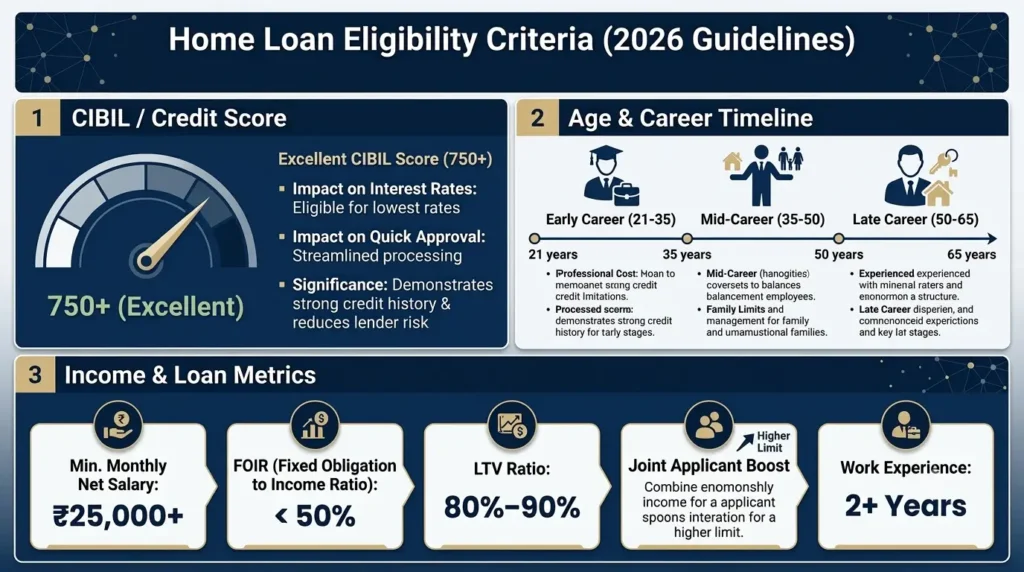
Most lenders look for a minimum net monthly income of ₹15,000 to ₹25,000, with applicants in metro cities generally expected to sit toward the higher end given the property values involved. This is a floor, not a target. The real ceiling on your loan amount comes from a calculation most competing guides mention only in passing: FOIR.
FOIR: The Ratio That Decides Your Number
Fixed Obligations to Income Ratio, or FOIR is the single mechanism that decides almost everything about your final number, and it deserves more attention than it usually gets.
FOIR measures the share of your net monthly income already committed to fixed obligations, existing EMIs, credit card minimums, and other recurring debt, before your new home loan EMI is even added. Most lenders cap total FOIR, including the new home loan, somewhere between 40 and 55 percent of net monthly income.
Here’s why this matters more than most buyers realise. An existing car loan EMI of ₹15,000 doesn’t just reduce your monthly cash flow. It directly reduces the home loan amount a bank will sanction, often by several lakh rupees, since that ₹15,000 is now permanently occupying space within your FOIR ceiling. Two applicants earning identical salaries can qualify for meaningfully different loan amounts purely because one is carrying an existing personal loan and the other isn’t. Before assuming your salary alone determines your eligibility, total up every existing EMI and recurring credit obligation you’re carrying. That number, not your salary, is often the real constraint.
CIBIL Score: Not Just Approval, But What You Pay
Most guides treat CIBIL as a simple pass or fail gate. It’s more useful, and more accurate, to think of it as a pricing variable that follows you for the entire loan tenure.
A score of 750 or above typically secures the best available rates and the smoothest approval process. 700 to 749 is usually still approved, but often with a small rate premium attached. 650 to 699 narrows your options considerably, approval becomes possible mainly through public sector lenders, and at a noticeably higher rate. Below 650, the risk of outright rejection rises sharply, and where approval is possible at all, the rate premium can be substantial.
That rate premium compounds meaningfully over a long tenure. A 0.5 percent difference in interest rate on a ₹50 lakh loan over 20 years can amount to ₹5 to 9 lakh in additional interest paid. Six months of disciplined score repair, paying down a revolving credit card balance, correcting a reporting error, isn’t just about getting approved. It can be worth several lakh rupees over your loan’s lifetime. Our detailed guide on CIBIL score and its significance in home loan approval covers exactly how to check and improve yours before applying.
Age and Tenure: Why the Two Are Linked
Your age doesn’t directly cap how much you can borrow. It caps how long you have to repay it, and tenure is what actually drives your eligible loan amount.
Salaried applicants generally need their loan fully repaid by age 60 to 65. Self-employed applicants are often given until age 70, reflecting the absence of a fixed retirement date. A 28-year-old applicant can realistically access a 30-year tenure, keeping monthly EMIs low relative to the loan amount. A 50-year-old applying for an identical loan amount might only be offered 10 to 15 years, pushing the EMI, and therefore the FOIR consumed, significantly higher for the same principal.(Source)
This is precisely why a younger applicant, income held equal, generally qualifies for a larger sanctioned amount than an older one: a longer tenure keeps the EMI low enough to fit comfortably within the FOIR ceiling. Our guide on how to decide your home loan tenure walks through this trade-off in more depth, including when a shorter tenure genuinely makes more sense despite the higher EMI.
Loan-to-Value: What the Bank Lends and What You Bring
Even a perfect income and credit profile doesn’t let you borrow the full property price. RBI’s loan-to-value, or LTV, norms cap this regardless of how strong your application otherwise looks.
Lenders can fund up to 90 percent of the property’s value for loans up to ₹30 lakh, 80 percent for loans between ₹30 and 75 lakh, and 75 percent for loans above ₹75 lakh. The remainder, 10 to 25 percent depending on your loan size, has to come from you directly, and this down payment sits entirely outside what any lender will finance. Registration charges and stamp duty aren’t funded at all, and need to be budgeted separately on top of the down payment itself.
This is the part of eligibility buyers most often underestimate, treating the income approval as the finish line when the down payment is an equally hard constraint. Our complete guide to home loan down payment impact and strategies covers how to plan for this properly, and our guide on saving for a down payment faster is worth reading well before you start seriously property hunting.

Eligibility if You Are Self-Employed
Self-employed applicants aren’t a footnote to this process. They’re assessed through a genuinely different lens, and it’s worth understanding that lens rather than applying salaried-employee assumptions to a very different evaluation.
Income is assessed from your Income Tax Returns, typically averaged across the last two to three years, rather than a single salary slip. Lenders look closely at business vintage, generally wanting to see the business established for a minimum period, and pay particular attention to the consistency of your bank statements and the stability of your declared profit year over year, sometimes more heavily than the absolute profit figure itself. A business showing volatile, wildly fluctuating profit tends to receive a more conservative income multiple than one showing steady, modest growth. Lenders often apply a somewhat more cautious income multiple to self-employed applicants generally, reflecting the inherently less predictable nature of business income compared to a fixed salary.
A strong, consistent bank statement, showing regular business inflows and sensible cash management, frequently carries more weight in a self-employed application than the ITR’s headline profit figure alone.
Property and Developer Approval: The Part Buyers Forget
Eligibility isn’t only about you. The property itself needs to clear the lender’s own checks, and this is where buyers who’ve secured strong personal approval sometimes still hit a wall.
Lenders maintain approved project lists for many developers, and financing a unit in an approved project is generally faster and smoother than one that isn’t. For an unapproved project, the lender conducts additional legal and technical due diligence, checking title clarity, RERA registration, and construction approvals independently, which can slow the process considerably or, in some cases, result in the lender declining to finance that specific project even for an otherwise strong applicant. Before falling in love with a specific unit, it’s worth confirming your preferred lender’s stance on that project early, rather than discovering a complication after you’ve already committed emotionally.(Source)
Worked Examples at Three Salary Levels
Numbers make this far more concrete than criteria alone, so here’s what three real income levels typically translate to, assuming no existing EMIs, a 20-year tenure, and an interest rate around 7.5 percent for a strong CIBIL profile.
₹40,000 monthly income: With FOIR capped around 50 percent, roughly ₹20,000 is available for EMI. This typically supports a sanctioned loan of approximately ₹22 to 24 lakh.
₹75,000 monthly income: With a similar FOIR cap, around ₹37,500 is available for EMI, supporting a sanctioned loan of roughly ₹42 to 45 lakh.
₹1,50,000 monthly income: Available EMI capacity rises to around ₹75,000, supporting a sanctioned loan in the region of ₹85 lakh to ₹90 lakh.
These figures shift meaningfully with tenure, rate, and any existing EMIs, but they illustrate the actual arithmetic behind the eligibility question far better than a criteria table does. An eligibility calculator built on older, higher rate assumptions will understate what a strong applicant can genuinely borrow today, since rates in 2026 sit noticeably lower than they did even two years ago.
Seven Ways to Increase Your Eligibility
If your current number falls short of what you need, several specific levers move the outcome, each to a different degree.
Add an earning co-applicant. This is often the single biggest lever available. A spouse earning ₹30,000 alongside your ₹40,000 can push combined eligibility close to double what you’d qualify for alone, since both incomes feed into the FOIR calculation together.
Close a small existing loan before applying. Paying off a personal loan or car loan with a modest remaining balance frees up FOIR headroom immediately, often worth several lakh rupees in additional eligibility.
Correct errors in your credit report. A wrongly reported default or an old, already-closed loan showing as active can quietly suppress your CIBIL score for no legitimate reason. Check your report and dispute errors before applying, not after a rejection.
Extend your tenure. A longer tenure lowers your monthly EMI for the same loan amount, which can meaningfully increase what you qualify for, though it does increase total interest paid over the life of the loan.
Improve your CIBIL score. Even a modest improvement, paying down revolving credit card balances specifically, can shift you into a better rate band within a few months.
Consider a builder subvention scheme, carefully. Some builders offer schemes where they cover interest during construction, easing near-term cash flow, though it’s worth understanding the real trade-offs first; our guide on builder subvention schemes covers exactly what to check before relying on one.
Reduce the loan amount needed. A larger upfront down payment, even a modestly larger one, directly reduces how much you need to borrow, sidestepping the eligibility ceiling rather than trying to raise it.
Documents You Will Need to Prove Any of This
Having documentation ready before you approach a lender speeds up the entire process considerably.
Salaried applicants typically need recent salary slips, Form 16 or ITRs for the last two to three years, bank statements showing salary credits, and identity and address proof. Self-employed applicants need ITRs for the last two to three years, audited financials where applicable, business registration proof, and bank statements for both business and personal accounts. Everyone needs property documents once a specific unit is identified, the agreement to sell, title documents, and, for under-construction property, the developer’s approvals and RERA registration.
Do’s
- Calculate your existing EMIs and recurring credit obligations before estimating eligibility.
- Keep your CIBIL score at 750 or above where possible to access better rates.
- Compare your eligible loan amount with the required down payment and property cost.
- Check whether your preferred lender has approved the project before committing to a property.
- Keep salary slips, ITRs, bank statements and property documents ready before applying.
- Identify the specific reason for rejection before making changes or reapplying.
Don’ts
- Treat your salary alone as the deciding factor in your loan eligibility.
- Ignore existing personal, car or other loan EMIs when estimating your borrowing capacity.
- Assume a strong CIBIL score guarantees the full amount you need.
- Forget that registration charges and stamp duty are outside the LTV-funded amount.
- Assume an unapproved project will automatically qualify for financing.
- Reapply immediately after rejection without addressing the underlying issue.
If You Are Rejected: What to Fix and When to Reapply
A meaningful share of readers on this exact topic won’t qualify for what they need on their first attempt, and that’s worth addressing honestly rather than glossing over.
Find out the specific reason first. Lenders are generally required to communicate why an application was declined, low CIBIL score, high FOIR, insufficient income, or a property-related issue. Don’t guess. Ask directly.
Once you know the reason, the fix is usually specific rather than vague: close a small existing loan if FOIR was the issue, correct a credit report error if the score was the problem, add a co-applicant if income alone fell short, or address a flagged property concern directly with the developer.
It’s generally worth waiting three to six months before reapplying, giving enough time for the improvement, a lower FOIR, a repaired score, updated income, to genuinely show up in your profile rather than reapplying immediately with essentially the same numbers. If EMI mistakes are part of what’s straining your existing obligations, our guide on common home loan EMI calculator mistakes first-time buyers make is worth reviewing before your next attempt.
A rejection today is information, not a permanent verdict. Most of the factors that caused it are genuinely within your control to change.
Key Takeaways
- FOIR is a major eligibility constraint: Most lenders keep total fixed obligations, including the new home-loan EMI, within roughly 40–55% of net monthly income.
- CIBIL affects both approval and pricing: A score of 750+ generally puts borrowers in the strongest position for competitive rates.
- Age affects tenure, which affects eligibility: Younger borrowers can generally access longer tenures and therefore lower EMIs for the same loan amount.
- LTV limits the property’s financeable value: Lenders can fund up to 90%, 80% or 75% depending on the loan-size bracket, with stamp duty and registration outside the financed amount.
- Self-employed applicants are assessed differently: ITR income, business vintage, bank statements and profit consistency carry significant weight.
- The property must also pass lender checks: RERA registration, title and construction approvals can affect whether a lender finances a particular project.
- Eligibility can be improved: A co-applicant, lower existing debt, better CIBIL score, longer tenure or larger down payment can materially change the amount you can borrow.